Articles
How to Integrate DBT Skills Into Therapy Sessions: a Guide for Clinicians
DBT skills are powerful—when taught at the right time. Here’s how to integrate them effectively.

After more than two decades of clinical practice, we’ve learned that the most powerful therapeutic tools are those our clients actually use—not just in session, but in the messy, complicated moments of their daily lives. Dialectical Behavior Therapy (DBT) skills have proven to be among the most practical and transformative interventions we’ve encountered, but their effectiveness hinges entirely on how and when we introduce them.
Below, we share the scenarios where DBT skills have brought the most value to our sessions, how to make them accessible and useful for clients, and what we wish we knew sooner about setting the therapeutic environment for skills to truly take hold.
Who can benefit the most from DBT skills training?
While DBT skills can benefit a wide range of clients, we’ve found that the following presentations signal that skills training is likely to be particularly helpful.
When a client’s emotion overwhelms their insight
Early in our careers, we made the mistake many therapists make: we tried to help clients gain insight into their emotional patterns while they were drowning in those very emotions. Linehan’s foundational work taught us that skills training must often precede insight-oriented therapy, particularly for clients with emotion dysregulation.
Watch for clients who describe emotions as “coming out of nowhere,” who feel hijacked by their feelings, or who can articulate what they should do differently but can’t seem to do it in the moment. These are your prime candidates for emotion regulation and distress tolerance skills.
When mindfulness is key to unlocking progress
We’ve learned something crucial over the years: before clients can regulate their emotions or navigate relationships skillfully, they often need to simply notice what's happening in the first place.
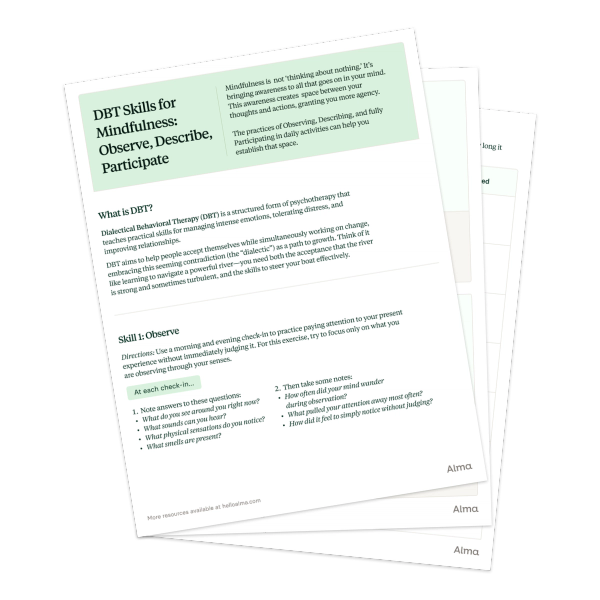
Mindfulness skills often provide the essential foundation that makes all other DBT skills possible. The core mindfulness practices—Observe, Describe, and Participate—create what we think of as the “pause button” between stimulus and automatic response.
We introduce these skills early and weave them throughout treatment, teaching clients to notice their heart rate increasing and thoughts moving quickly rather than declaring “I’m completely overwhelmed.”
This shift from reactive judgment to neutral observation becomes the scaffolding on which distress tolerance, emotion regulation, and interpersonal effectiveness skills are built. The mindfulness worksheet tracking—where clients practice observing morning sensations, describing emotions neutrally, and participating fully in everyday activities like brushing teeth or eating meals—provides concrete, accessible entry points into what can otherwise feel like an abstract concept.
When clients are stalled in crisis mode
Here’s something we’ve observed repeatedly: clients in active crisis are often the least able to learn new skills, yet they need them most urgently. We’ve learned to introduce one simple distress tolerance skill—usually TIPP (Temperature, Intense exercise, Paced breathing, Paired muscle relaxation) or grounding techniques—and practice it together in session before the next crisis hits.
We keep our language simple during these moments: “Your system is in fight-or-flight right now. Before we talk this through, let’s get your nervous system to a place where it can actually process what we’re discussing.” The TIPP skills are particularly effective here because they work directly on the nervous system, creating rapid physiological shifts that make emotional regulation possible.
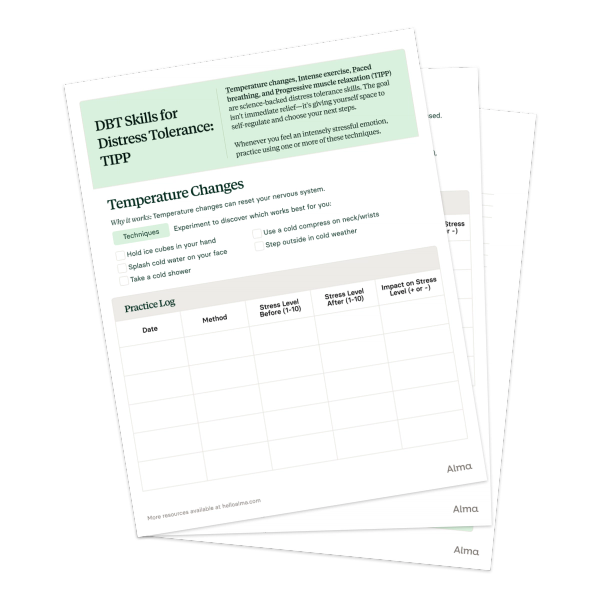
The TIPP protocol offers immediate intervention options:
- Temperature: Cold water on the face or holding ice activates the dive reflex, rapidly calming the autonomic nervous system
- Intense exercise: Brief bursts of physical activity (20 jumping jacks, running stairs) can shift emotional states within seconds
- Paced breathing: Box breathing (inhale-4, hold-4, exhale-4, hold-4) signals the nervous system that the emergency has passed
- Progressive muscle relaxation: Systematic tensing and releasing of muscle groups promotes full-body relaxation
We practice these in session first. We’ll have a client splash cold water on their face right there in the office, or we’ll do jumping jacks together (if they are physically able, of course). This experiential learning is crucial—they need to know these skills work before the next crisis hits.
When relationship patterns have physical foundations
After hearing a client describe their third or fourth interpersonal conflict with the same underlying pattern, we know it’s time for interpersonal effectiveness skills. But we’ve also learned that interpersonal skills often fail when the foundation isn’t solid—that’s where the PLEASE skill becomes essential.
The PLEASE acronym addresses the physical foundations of emotional regulation:
- PL (Treat PhysicaL Illness): Untreated medical issues directly undermine emotional resilience
- E (Balance Eating): Skipped meals and blood sugar crashes trigger emotional dysregulation
- A (Avoid Mood-Altering Substances): Caffeine, alcohol, and other substances create emotional instability
- S (Balance Sleep): Sleep deprivation is one of the most significant predictors of emotional vulnerability
- E (Get Exercise): Physical activity functions as natural mood regulation
We’ve found that clients struggling with interpersonal effectiveness often need to start with PLEASE. Someone who’s sleep-deprived, running on caffeine, and skipping meals simply doesn’t have the emotional bandwidth for skillful communication. We introduce PLEASE early and revisit it regularly throughout treatment.
How to integrate DBT skills into individual therapy sessions
Start where the pain is
We used to follow DBT’s traditional sequence religiously: mindfulness first, always. But we’ve found that when a client comes in after a weekend of self-harm urges or a devastating breakup, they need relevant skills immediately. Now we start with whatever module addresses their most pressing concern.
For a client in acute distress, we might begin with TIPP skills in the first session. For someone whose life feels chaotic due to poor self-care, we start with PLEASE and use the structured worksheets to create immediate, trackable change. This isn’t departing from DBT’s spirit—it’s honoring its dialectical foundation.
Make it experiential, not academic
We cringe when we think about our early attempts at skills training—essentially lecturing clients about acronyms and expecting them to implement these in moments of distress. That’s not how people learn to regulate their nervous systems.
How do you teach TIPP skills in a therapy session?
To introduce the TIPP skills, practice them together in session:
- Ask the client to recall a recent triggering situation, notice what happens in their body as they remember it, and then actually walk through each component.
- Keep ice packs in the office, specifically for teaching temperature-based regulation.
- Demonstrate paced breathing together, counting out loud until the rhythm becomes natural.
For PLEASE skills:
- Use tracking worksheets during the session
- Complete the first week together, identifying specific meal times, sleep schedules, and exercise options.
- The worksheet becomes a collaborative tool rather than homework that gets ignored.
Use a three-part structure
We’ve settled into a three-part rhythm with skills introduction that works well:
1. Introduce the skill with rationale and psychoeducation. “When your nervous system is in crisis mode, talking doesn’t help yet. The TIPP skills work directly on your physiology to bring you back to a place where you can think clearly.”
2. Practice together in session. This is where the learning really happens—not in the explanation, but in the doing. We spend 10-15 minutes of each session in active skills practice.
3. Create a specific, individualized plan using worksheets. Not “practice TIPP,” but “When you feel the panic rising at night, start with paced breathing. If that doesn’t bring your distress down within 2 minutes, splash cold water on your face. Track what happens and bring the worksheet next week.”
How to adapt DBT skills training for group settings
Group therapy offers unique advantages for DBT skills training. In our weekly skills groups, we’ve found that the structured format creates safety while peer learning accelerates skill acquisition.
We typically run 90-minute groups with consistent format:
- Check-in (15 minutes): Brief sharing of the week’s challenges and successes
- Skills review (20 minutes): Members share their worksheet tracking and what they learned
- New skill introduction (30 minutes): Teaching and demonstration of one specific skill
- Practice and planning (20 minutes): Members practice the skill and complete worksheets together
- Closing (5 minutes): Commitment to practice before next session
The power of peer learning
Something remarkable happens when a group member shares how they used TIPP skills to get through a panic attack without self-harming. Other members lean forward. They ask questions. They believe it might work for them because they just heard it from someone who understands their struggle.
We've found that group members often explain skills to each other more effectively than we do. They use language that resonates with their peers. They troubleshoot barriers we might not have considered. The group becomes a laboratory for testing skills and a support system for maintaining practice.
Worksheets as group tools
TIPP and PLEASE worksheets are resources that function beautifully in both individual and group settings. We project them on screen and complete sections together. Members share their tracking logs, noticing patterns collectively. “I see you rated sleep a 3 all week and your emotional intensity was 8-9 every day—does anyone else notice that connection?”
The tracking becomes accountability. Members know they'll share their worksheets next week, which increases follow-through. They compete gently with each other—“You did paced breathing practice three times a day? I’m going to try to do that this week.”
Working with resistance in individual and group sessions
After years of practice, we’ve learned that “resistance” to skills usually reflects one of several things: the skill wasn’t clearly explained, it doesn’t fit the client’s values or context, they tried it during an inappropriate moment, or—most commonly—they feel ashamed that they need “basic” coping skills.
When a client reports that skills “aren’t working” we get curious rather than persuasive. “Tell me what happened when you tried it. Walk me through exactly what you did.” Usually there’s a misunderstanding we can address.
In groups, resistance often surfaces as eye-rolling or disengagement. We address it directly: “I notice some people checking out. What’s happening?” Often someone will voice the doubt that everyone’s feeling: “This seems too simple to work for real problems.” That creates space for honest dialogue about expectations and gradual trust-building.
The therapeutic relationship remains the foundation in both individual and group work. Research consistently shows that the quality of the therapeutic alliance predicts outcomes even in structured, skills-based treatments like DBT. Skills without connection feel empty; connection without skills can feel insufficient. We need both.
What we wish we’d known earlier about DBT skills training
Skills don’t replace the relationship
In our enthusiasm for DBT early on, we sometimes lost sight of the foundational therapeutic relationship. We’ve since learned that the skills are the “what,” but validation and authentic connection are the “how.” Clients need to feel genuinely understood before they can take in new strategies. This is true whether you’re working individually or facilitating groups.
Small wins matter more than perfect implementation
We used to get discouraged when clients didn’t master entire skill modules. Now we celebrate when someone uses any skill, even imperfectly. “You noticed you were getting angry and took three deep breaths before texting your sister back—that’s huge.” We highlight these moments in group, creating a culture where progress is recognized and reinforced.
In group settings, we point out partial successes constantly. “You didn’t complete the whole PLEASE worksheet, but you tracked your sleep for four days and noticed the pattern with your mood—that’s exactly the kind of awareness we’re building.”
Integration across settings
The skills work best when reinforced across contexts. We encourage individual therapy clients to join skills groups when available. We coordinate between individual and group clinicians, sharing what skills are being emphasized and what barriers are emerging.
For clients in individual therapy only, we create artificial peer accountability by having them imagine explaining their skills practice to others. “If you were going to tell someone else how the temperature skill helped you this week, what would you say?”
Honoring your client’s capacity for change
In reviewing our experience, what strikes us most is how DBT skills become woven into clients’ lives in unexpected ways. The skills work not because they’re magic, but because they’re practical, evidence-based, and—when introduced with genuine care and attention to individual context—they give people agency over experiences that once felt unmanageable.
The art is in the introduction: meeting clients where they are, making skills relevant to their specific struggles, practicing together until strategies feel accessible rather than academic, and maintaining faith in the process even when progress feels slow. Whether in individual therapy or group settings, the structured worksheets for skills like TIPP and PLEASE provide the concrete guidance that transforms abstract concepts into lived change.
Because here’s what we’ve learned: people are remarkably capable of change when given the right tools at the right time, delivered within a relationship—or community—that honors their dignity and potential. DBT skills are some of the best tools we have. Our job is to pass them along with skill, compassion, and hope.

Written by
Drs. Jill Krahwinkel-Bower and Jamie Bower

Learn More
Build a thriving private practice with Alma
We believe that when clinicians have the support they need, mental health care gets better for everyone.